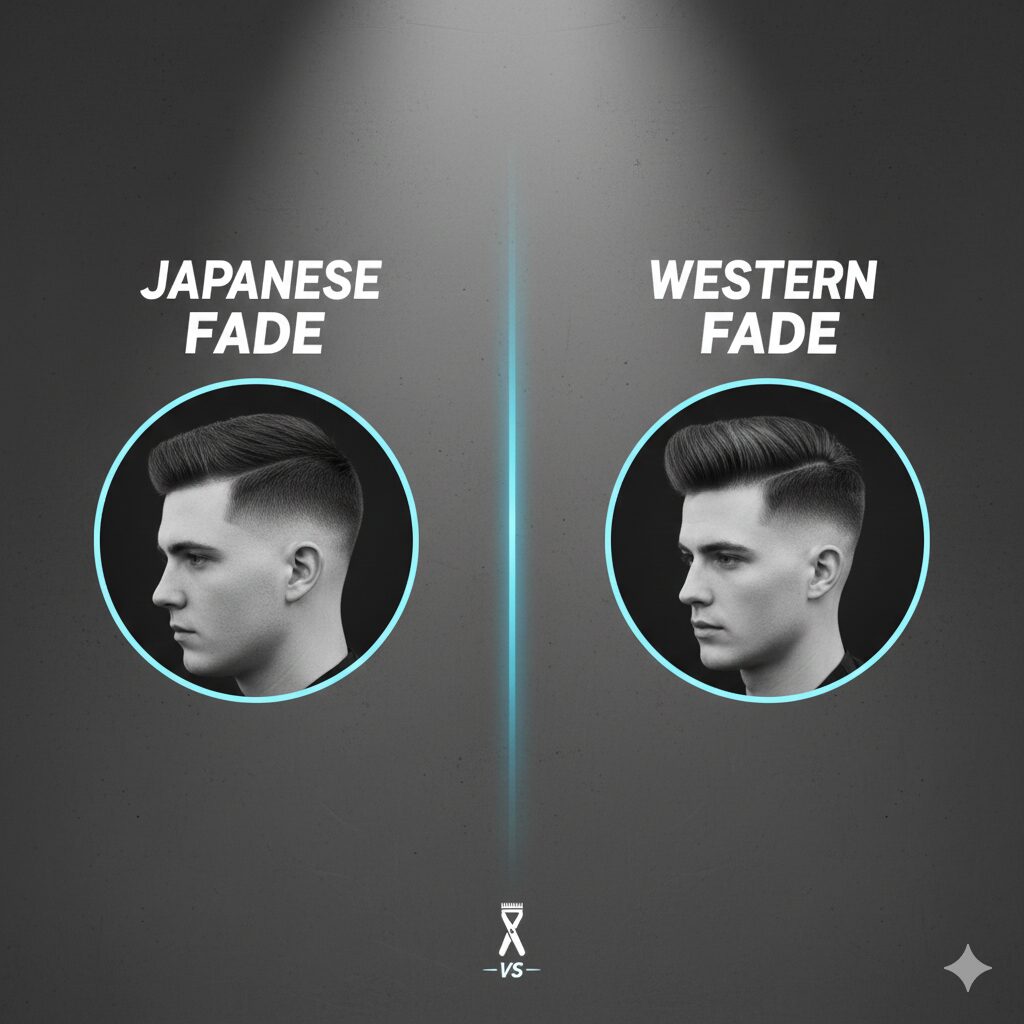
Quick answer: Both are called “fade,” but they aim at different things. A Japanese fade is built to disappear smoothly; a Western fade is built to show contrast. Neither is better — but if you want the Western version here, you have to say so.
Visitors who get a fade in Japan often say the same sentence afterwards:
“It looks good… but it’s a little different from what I expected.”
That’s not a skill gap. It’s a difference in what “finished” means.
Where the Japanese Fade Came From
Worth knowing, because it explains everything else: the word fade only became common in Japan relatively recently.
Before that, barbers here called this work a gradation cut (グラデーション) — and that word tells you the goal. A gradation is something you’re not supposed to see the edges of. Decades of training went into making the transition invisible.
So when a Japanese barber does a fade, the instinct built into their hands is erase the boundary. A Western barber’s instinct is often the opposite: define the boundary.
The Japanese Fade
Three values drive it:
- Precision — no visible steps, no unevenness, no harsh lines
- Blending — a soft boundary between skin and hair
- Overall balance — the fade isn’t a feature on its own; top, sides and back are designed as one shape
The physical reason behind it
This part is rarely explained, and it matters.
Most Japanese clients have very dark, straight hair against relatively light skin. That combination produces maximum contrast automatically. An unblended fade on that hair type doesn’t read as “bold” — it reads as rough or unfinished.
So the aesthetic here evolved toward softening what’s already high-contrast. On different hair — curlier, lighter, more textured — a hard line looks intentional. On dark straight hair it often just looks like a mistake.
Once you know that, the Japanese preference stops looking like timidity and starts looking like a response to the material.
The Western Fade
- Strong contrast — very short at the bottom, clear boundaries, bold length differences
- Skin emphasis — cut down to visible skin, with a rapid climb upward
- Top vs sides — volume and texture left on top, and the contrast itself becomes the style
Where a Japanese fade aims for flow, a Western fade aims for statement. Deep shadows, visible structure, sometimes intentionally visible steps.
The Friction Point
Here’s exactly where it goes wrong. Visitors think:
- “I wanted the bottom much shorter.”
- “It’s too clean — it doesn’t stand out.”
- “Where are the lines?”
Meanwhile the barber is quietly pleased, because making the fade disappear cleanly is the correct finish by the standard they were trained in.
Two people, both satisfied with the technique, disagreeing about the destination.
How to Ask for the Western Version
This is the practical heart of the article. Say one of these and the whole thing changes:
- Shorter at the bottom — “Shorter here, please.” (point)
- More contrast — “I want more contrast.” / “Not too natural.”
- Skin fade — “Skin fade, please.” / “Zero millimeters at the bottom.”
- Visible steps, not a smooth blend — “Not too blended.” / “Clear difference between lengths.”
- Best of all — “Like this photo. Same contrast, please.”
That last phrase does the most work. A photo plus the word contrast removes the ambiguity completely. (More on using photos well.)
Which One Should You Actually Get?
If you’re traveling, this is worth thinking about for a second.
Go Western/high contrast if…
You’re near the end of your trip, you have a specific look you maintain at home, or you’ll get another cut within two or three weeks. Sharp skin fades look best for a short window and then need attention.
Go Japanese/blended if…
You still have weeks of travel ahead, or you won’t get to a barber again for a while. A gradual fade grows out far more gracefully — there’s no hard line to become a stripe as it fills in. That’s a real practical advantage on a long trip.
Plenty of visitors also just try the Japanese version deliberately, because it’s the one you can’t easily get at home.
Two Misunderstandings to Drop
“Japanese fades aren’t as good.” The direction is different, not the skill level. The precision required to make a gradation genuinely invisible is not lower than the precision required for a hard line.
“The Western fade is the correct fade.” It’s the more globally visible one, which isn’t the same thing.
Summary
- ✔ Japanese fade = erase the boundary; Western fade = define it
- ✔ The difference comes from hair type and history, not skill
- ✔ Say “more contrast” or “not too blended” if you want the Western look
- ✔ A photo plus the word “contrast” is the most reliable order
- ✔ Blended fades grow out better — useful on a long trip
Both are beautiful. They’re just aiming at different finishes — and now you can pick which one you’re aiming at too.
Let’s BARBER!! 💈
Next Steps
👉 How to Order a Fade in Japan: High, Mid & Low
👉 Clipper Length in mm: How to Ask
👉 What Actually Happens in the Chair During a Fade


Comments