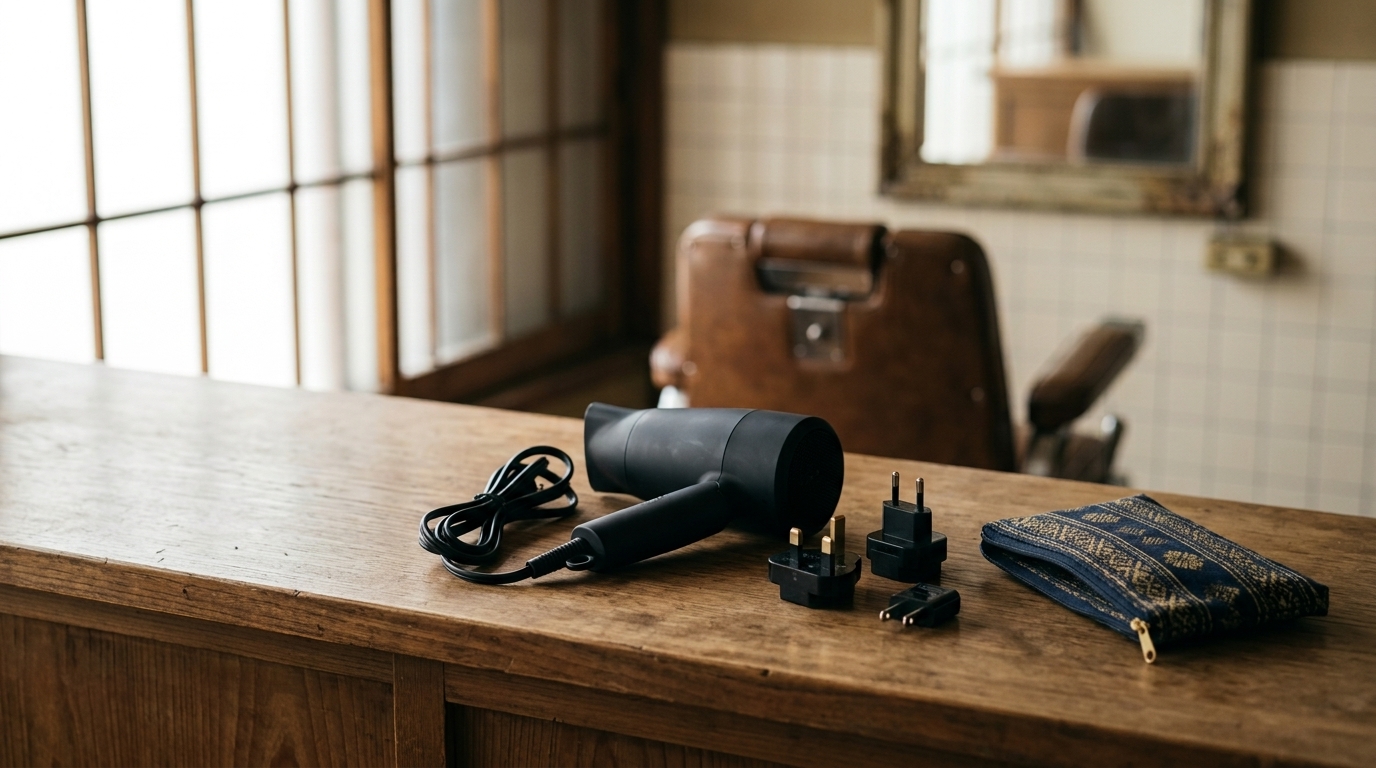
Welcome to Japan! Whether you’re planning a trip or already here.
Ever wondered, “If I buy a hair dryer in Japan, will it work back home?”
Japanese hair care products are popular around the world. But electricity works differently from country to country. Use the wrong dryer, and it can break or even damage your hair and scalp.
In this article, a working Japanese barber gives you the simple answer.
The short answer: look for “100-240V”
Check the label on the dryer or its cord. If it says “100-240V,” it will work abroad. All you need is a plug adapter to fit the outlet.
If it only says “100V,” it’s made for Japan only. Please don’t use it overseas.
Japan’s electricity basics
Japan runs on 100V, one of the lowest voltages in the world. Most countries use 110 to 240V.
Japanese outlets are Type A, with two flat parallel pins. Japanese hair dryers use the same plug.
Quick guide by country
We picked the countries where most of our readers live.
| Country | Voltage | Plug type | Japan-only (100V) dryer |
|---|---|---|---|
| UK | 230V | Type G (three large pins) | Won’t work |
| Germany | 230V | Type C / F (two round pins) | Won’t work |
| USA | 120V | Type A / B | Plugs in, but don’t use it |
| Canada | 120V | Type A / B | Plugs in, but don’t use it |
Watch out in the US and Canada. The outlets look the same as Japan’s, so the plug fits right in. But the voltage is 120V, higher than Japan’s. Just because it fits doesn’t mean it’s safe.
Why a voltage converter isn’t the answer
You might think, “Can’t I just use a voltage converter?” For hair dryers, we don’t recommend it.
Hair dryers draw a lot of power. A converter that can handle that is big and heavy, not something you want to pack. Small travel converters usually can’t keep up.
Remember: a plug adapter only changes the shape of the plug. It does not change the voltage.
A word from a barber: a hair dryer does more than dry
- Adds volume
- Tames frizz and cowlicks
- Sets the shape
Blow-dry builds the base. Styling product locks it in. That’s the order Japanese barbers finish a cut.
If you don’t usually use a dryer, you’ll notice the difference.
How to choose
- Check the label for “100-240V”
- Get the right plug adapter for your country
- Check the model, because voltage support can differ even within one brand
Number 3 is easy to miss. Even with the popular Japanese brand KINUJO, only the Voyage (model HW001) supports overseas voltage. The standard model and the Pro are Japan-only.
KINUJO Hair Dryer Voyage (HW001): AC100-240V, about 290 g. Plug adapter sold separately. (Official product page)
How to make your dryer last: tips from a barber
From someone who uses a dryer every day: hair dryers break for three main reasons.
- Worn internal parts: With long use, parts wear out. If you smell burning, hear strange noises, or it suddenly stops, stop using it.
- Dust and hair buildup: Clean it whenever you notice. Think of it like cleaning the lint filter on a clothes dryer.
- Damaged cord (this is the big one!): Most people wrap the cord tightly around the dryer. Just leave a little slack where the cord leaves the dryer, and you’ll prevent breaks. Using a dryer with a half-broken cord can cause smoke, overheating, or sparks.
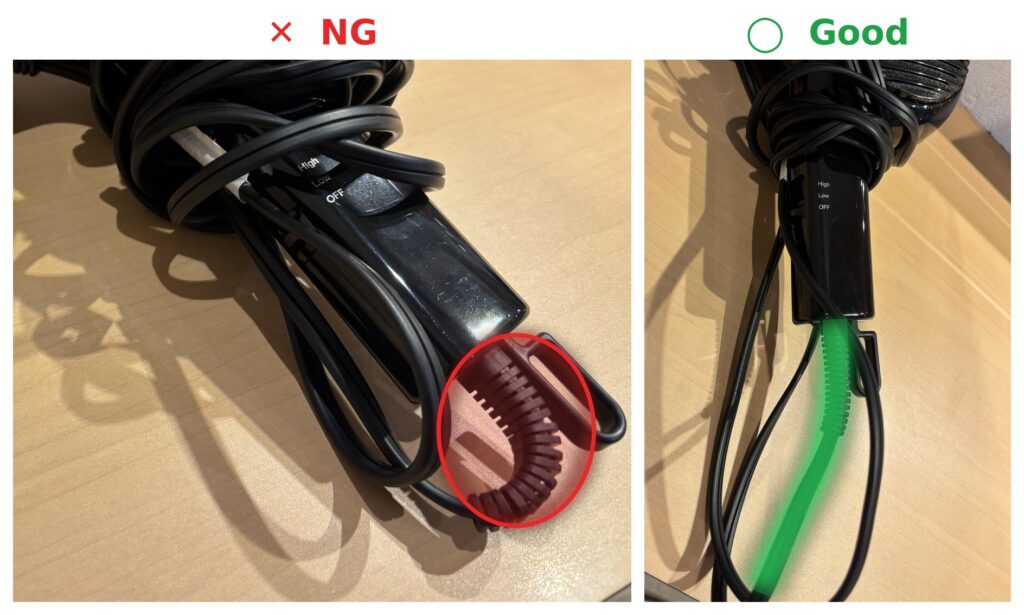
Number 3 happens a lot when you pack a dryer in your suitcase. Take care of it, and it will last.
While you’re in Japan
You don’t need to bring a dryer to Japan. Most hotels here provide one.
If you’re bringing your own from home, check for the same “100-240V” label.
Summary
- “100-240V” on the label: works abroad with just a plug adapter
- “100V” only: Japan-only. Don’t use it, even if it fits
- Voltage converters aren’t a good fit for hair dryers
- The dryer builds the base; styling product locks it in
Bring the Japanese barbershop finish home with you.
Let’s BARBER!! 💈

Comments