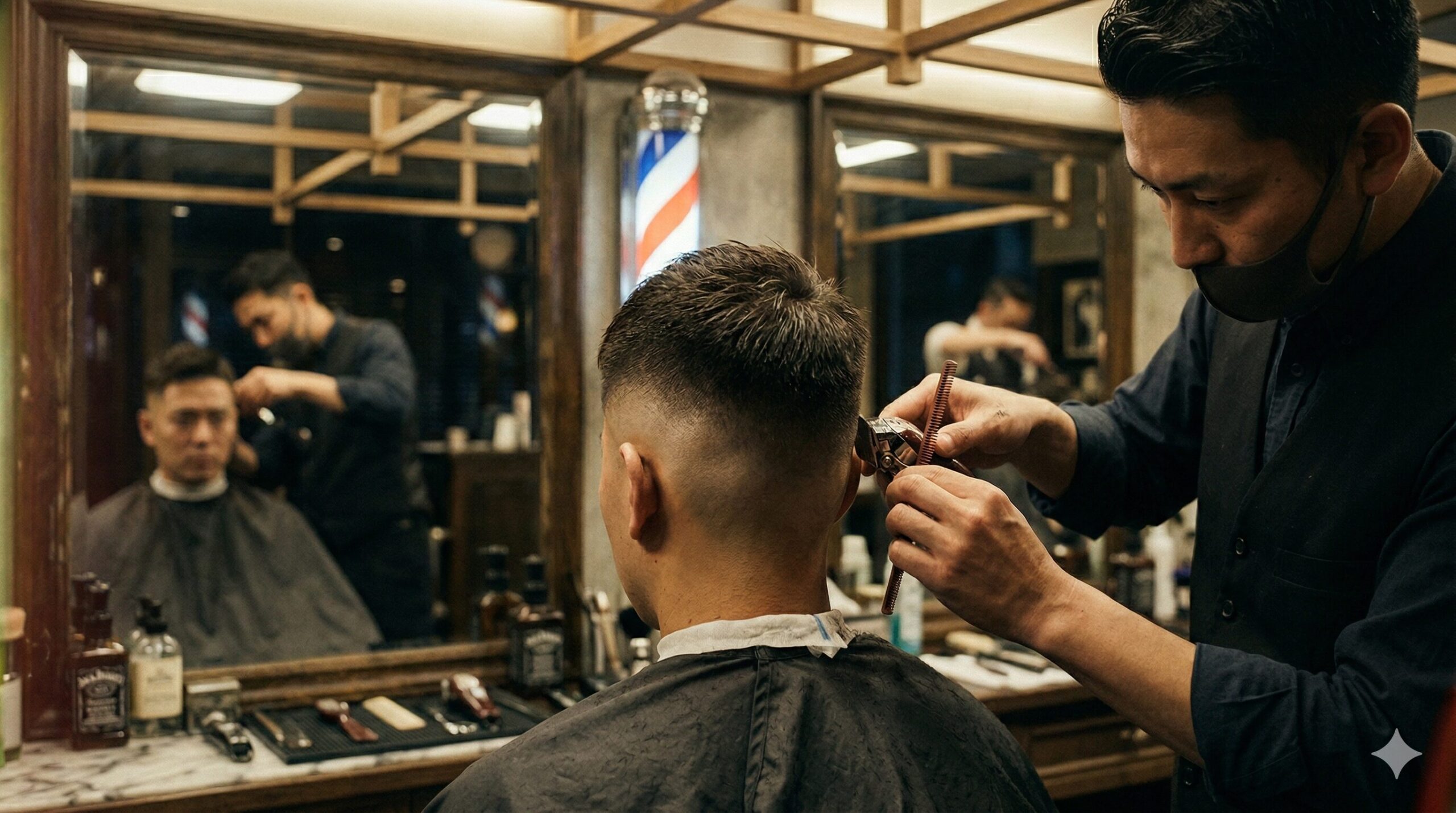
Quick answer: Yes — Japanese barbers are very good at fades. The difficulty isn’t the skill, it’s the experience. A fade genuinely looks wrong in the middle, and nobody warns you about that. Here’s exactly what’s happening at each stage.
You’re in the chair. The cape is on. There’s no turning back. And somewhere around the ten-minute mark, you glance in the mirror and think: …did they understand me?
I’ve watched that exact expression hundreds of times. Let me take you through what’s actually going on.
First: Are They Actually Good at Fades?
Yes. Japanese barbers are known for millimetre-level precision — careful blending, clean transitions, and a strong focus on the overall silhouette rather than just the fade line.
The technical quality is genuinely high. (The one thing worth knowing is that the aesthetic can differ from a Western fade — that comparison is here.)
So Why Does It Feel So Uncomfortable?
Because you’re watching a process, not a result.
A fade is built in layers. At several points during that build, the hair on your head does not look like the photo you showed. That’s not a mistake — it’s the middle of the method.
The Four Stages of a Fade
Stage 1 — Building the base
The barber takes the sides down first to establish the overall shape.
What you’ll see: blunt, unfinished, possibly a visible step between lengths.
What you might think: “That’s way too short.”
What’s actually happening: nothing is blended yet. Every fade starts as a hard line that will be erased later.
Stage 2 — Blending
Now the lengths get connected — say 3mm easing into 1.5mm, then down to 0.8mm at the bottom.
What you’ll see: the barber going over the same small area repeatedly, often with several different guards.
What you might think: “Is something wrong? Why do they keep redoing it?”
What’s actually happening: this is the fade. The repetition is the technique — each pass removes a little more of the boundary between two lengths.
This is where most people quietly panic. Give it a few more minutes.
Stage 3 — Connecting the top
The barber balances the sides against the top, managing weight and volume where they meet.
What you’ll see: scissors instead of clippers, and the shape suddenly starting to make sense.
What’s actually happening: this is where a fade stops being “short sides” and becomes a haircut. If you were worried at Stage 2, this is usually the moment the worry lifts.
Stage 4 — Detailing
Lines cleaned, stray hairs removed, balance checked from several angles — often with a razor at the neckline and around the ears.
Japanese barbers spend a noticeable amount of time here. It’s the stage that makes the difference you’ll notice three days later, when the cut still looks deliberate.
The Real Source of the Anxiety
It’s simple, and once you name it, it mostly disappears:
During the fade → “Did they get it wrong?”
After the finish → “Oh. This actually looks great.”
That gap between the two thoughts is the whole problem. A fade looks worse before it looks better — every single time, for everyone.
When You Should Actually Speak Up
Not all mid-cut worry should be swallowed. Here’s the honest guide:
Wait, don’t worry
- It looks blunt or stepped early on
- The barber keeps going over the same spot
- The top hasn’t been touched yet
Say something now
- The fade is starting higher on your head than you wanted
- The overall length is clearly shorter than you asked for
- Something is happening to the top that you didn’t request
Height and length can’t be undone. Blending can always be adjusted. So the rule is: speak up about where and how short, relax about how it currently looks.
How to Say It Without Any English
Keep it to one short sentence and a finger:
- “Not too short here.” (point)
- “This part, please.”
- “A little lower.” — for fade height
- “Can I see the back?” — before the finish, not after
Stopping a barber mid-cut is completely normal in Japan. It’s far better than staying silent and hoping. Nobody will be offended — we’d much rather adjust now than see a polite face at the end.
One More Thing About the Silence
You may notice the barber barely speaks during a fade. That’s concentration, not coldness — the blending stage in particular takes real attention.
If the quiet itself is what’s making you uneasy, there’s a whole guide to that here — including how to start a conversation if you’d prefer one.
Summary
- ✔ Japanese barbers are genuinely skilled at fades
- ✔ A fade is built in four stages and looks unfinished for most of them
- ✔ Repetition over one spot is the technique
- ✔ Speak up about height and length; wait on everything else
- ✔ One short sentence and a pointed finger is enough
You don’t need to understand every step. You just need to know that the middle isn’t the end.
Let’s BARBER!! 💈
Before Your Fade
👉 How to Order a Fade in Japan: High, Mid & Low
👉 Clipper Length in mm: How to Ask
👉 Showing a Photo: How to Make It Work


Comments