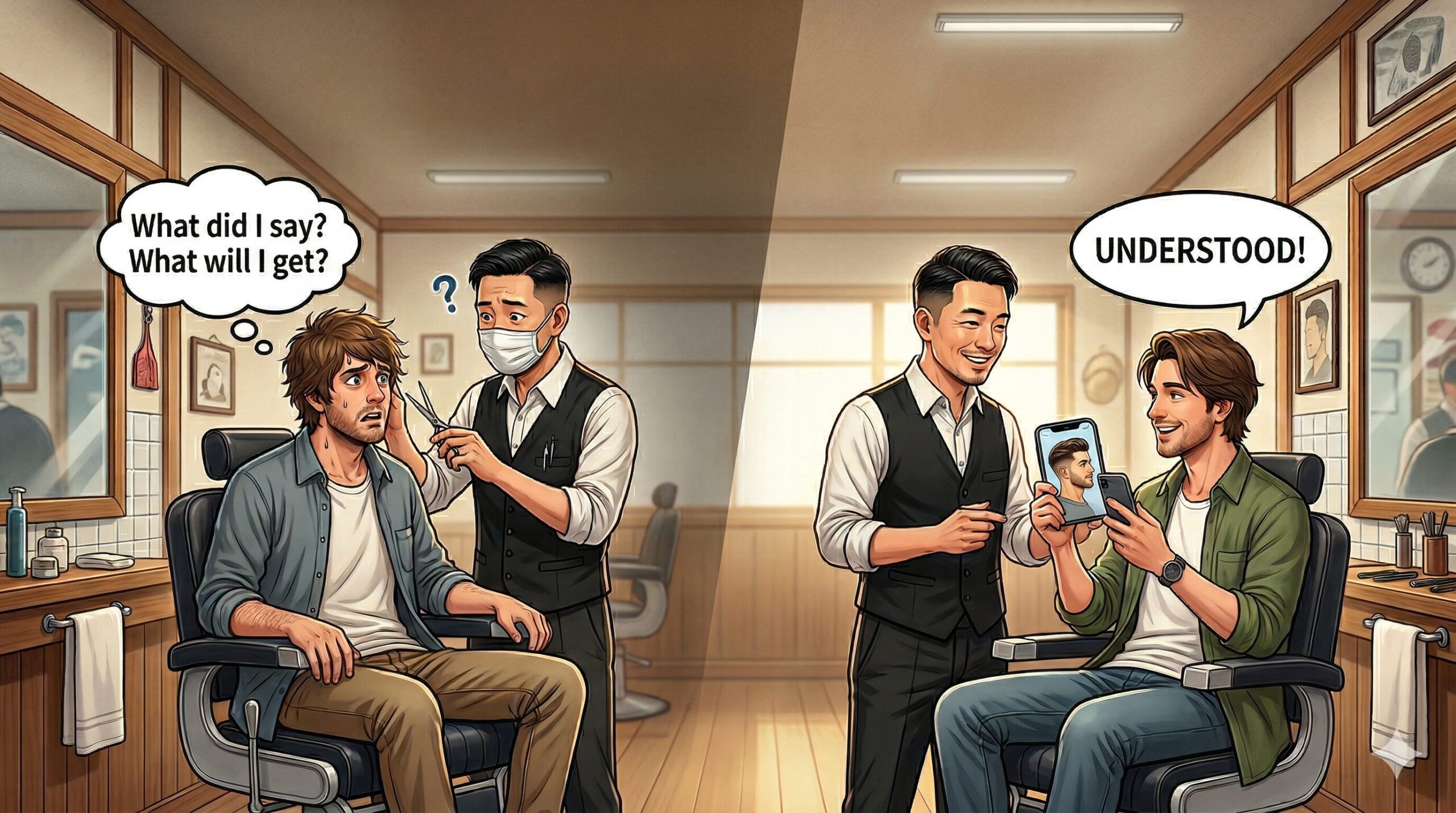
Quick answer: In Japan, “same as last time” usually doesn’t work — because your “last time” isn’t stored anywhere. Name one specific thing you want to keep, and the whole problem disappears.
You sit down. You meet the barber’s eyes in the mirror. “How would you like your haircut today?”
You think for a second and say: “Same as last time.”
A brief pause. The cut begins. Something feels slightly off. And when it’s finished: “…this isn’t quite what I expected.”
Here’s why that happens — and the one-line fix.
- Why “Same as Last Time” Fails Here
- The Real Problem Isn’t Your English
- The Template: Photo + One Sentence
- Sentences You Can Use Today
- A Japanese Trick: Describe It by Season
- Your Barber Is Nervous Too
- Be Extra Careful If This Sounds Like You
- And If the Words Still Don’t Come — That’s Fine
- Summary
- Want the Sentences Ready in Your Pocket?
Why “Same as Last Time” Fails Here
Your “last time” isn’t shared
At most Japanese barbershops:
- You may not get the same barber every visit
- Detailed cutting records often aren’t kept
- Even when notes exist, the nuance isn’t in them
So your mental picture of “last time” and your barber’s simply don’t match. Nobody did anything wrong — the reference point just doesn’t exist.
Vague words don’t survive translation
“A little shorter.” “Same as before.” Even between two Japanese speakers, those land differently. Add a language gap and the difference widens.
The Real Problem Isn’t Your English
Most people tell me the same thing: “I don’t know how to explain it.” “My English isn’t good enough.”
Honestly? That’s not it.
You don’t need more vocabulary. You need a template. Without one, no amount of research helps — you still end up saying “same as last time” because it’s the only sentence that’s ready to go.
Why you freeze at the door
You’re standing outside the shop. Your hand is on the door. And your mind starts running the numbers:
- What if they say no?
- What if it goes wrong?
- Will it be too short?
- Can this barber even do the style I want?
Reassurance on one side, risk on the other — and the risk always feels slightly heavier. So you pick safety. “Same as last time.”
That’s not a language problem. That’s a template problem. Here’s the template.
The Template: Photo + One Sentence
Everyone says “just show a picture.” True — but it stops there, and the real question is what do I say alongside it?
This is the whole thing:
Show a photo → add one simple sentence.
For example: “I want this style, but a bit longer on top.” That’s enough to start a real conversation. (More on how to use photos properly here.)
Sentences You Can Use Today
If you want roughly the same as before:
- “Same length as before.”
- “Just a little shorter.”
- “Keep the top, clean the sides.”
If you want a change but can’t describe it:
- “I’m not sure how to explain it, but something like this.”
- “I want to change, but not too short.”
- “What do you think would suit me?”
That last one is underrated. It hands the problem to the person who does this all day — and most Japanese barbers genuinely enjoy being asked.
One extra detail that helps a lot
Add this and your barber instantly has a reference point:
“It’s been about four weeks since my last haircut.”
Now they know roughly how much has grown, and how much to take off.
A Japanese Trick: Describe It by Season
Here’s something you won’t find in a phrasebook. In Japan, people often describe a hairstyle by the feeling of a season:
- Spring — lighter, more movement
- Summer — short and clean
- Autumn — balanced
- Winter — longer, heavier
So you can say: “Something lighter, like spring.”
It sounds vague in English, but to a Japanese barber it communicates a surprising amount of nuance — weight, movement, and how it should feel day to day. Try it.
Your Barber Is Nervous Too
This changes how the whole situation looks.
We don’t want to get it wrong. But we may not have the English to ask the follow-up questions that would prevent it. So when you say “same,” it doesn’t make our job easier — it makes it harder. We’re now guessing on your behalf.
One specific detail from you removes that pressure from both of us.
Be Extra Careful If This Sounds Like You
- You’re particular about your hair
- You always go to the same barber back home
- You tend to skip explanations
Those three habits work fine with a barber who knows you. In Japan, with a barber meeting you for the first time, they’re exactly what causes the mismatch.
And If the Words Still Don’t Come — That’s Fine
Let me say this clearly, because a lot of people need to hear it.
Not being able to explain your haircut well is not rude, not embarrassing, and not your fault.
In an unfamiliar country and an unfamiliar shop, words disappear. That’s not an English problem or a Japanese problem — it’s a comfort problem, and it happens to everyone.
Three things are genuinely enough:
You can show a photo.
You can answer Yes or No.
You can say “this is a little different” partway through the cut — stopping us mid-haircut is completely normal, and far better than staying quiet.
And honestly, from my side of the chair: barbers aren’t looking for customers who explain well. We pay more attention to the people who look unsure. Checking, confirming and adjusting together is the job — not judging how fluently you describe it.
Summary
- ✔ “Same as last time” is convenient — and risky here
- ✔ Be just slightly more specific
- ✔ Photo + one sentence beats everything
- ✔ Mention how many weeks it’s been
- ✔ “What do you think would suit me?” is a perfectly good sentence
The one trick worth remembering: when you’re tempted to say “same as last time,” name one thing you want to keep instead. Just one. That alone removes most misunderstandings.
You don’t need perfect English. You need one ready sentence — and now you have several.
Let’s BARBER!! 💈
Want the Sentences Ready in Your Pocket?
👉 Download the Japanese Barber Counseling Sheet — ¥500
Point and choose: length, fade height, thinning, shaving. Nothing to explain.
Next: 👉 How to Order a Fade in Japan: High, Mid & Low
Also useful: 👉 10 Must-Know Japanese Barber Phrases


Comments