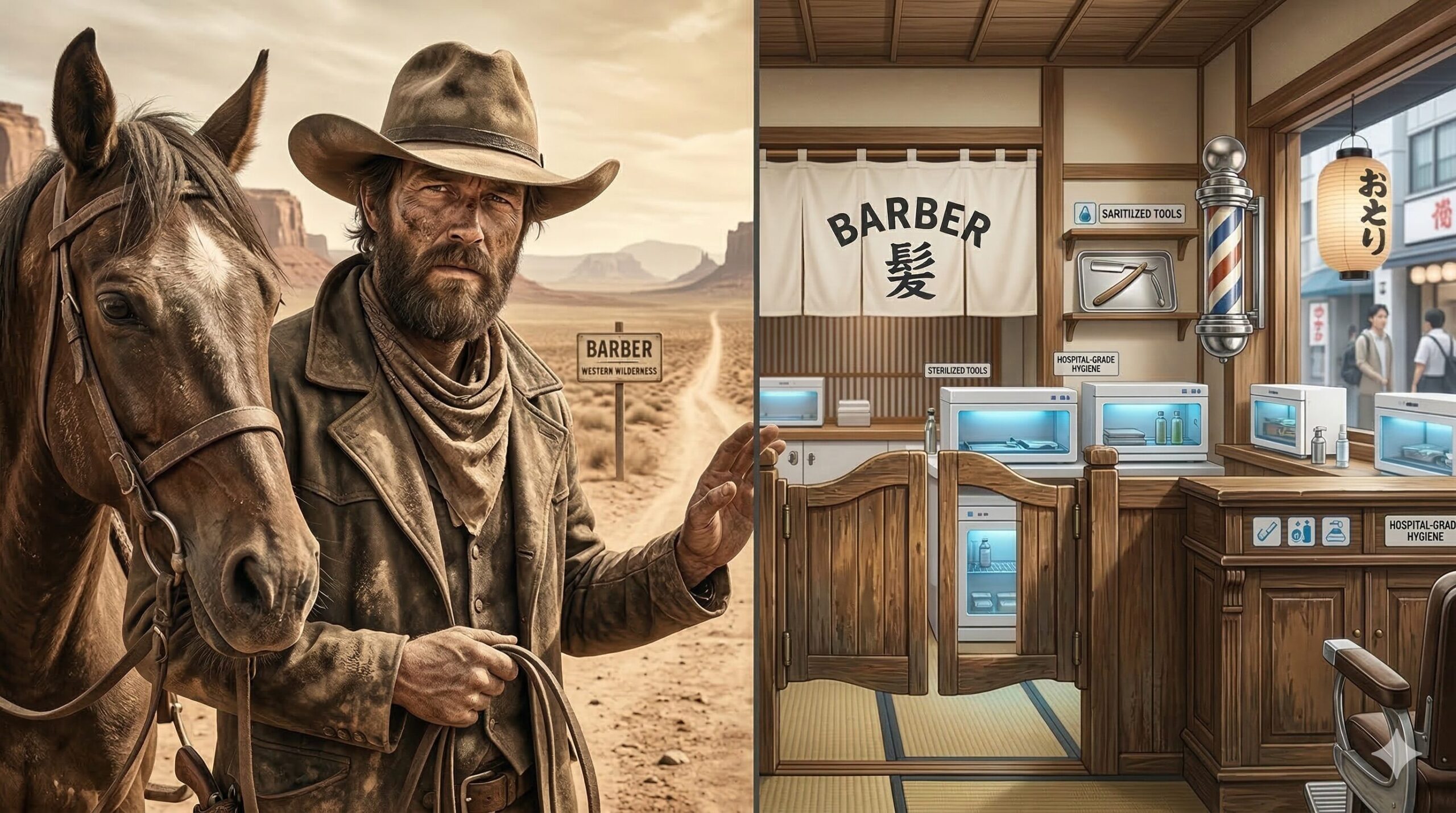
Quick answer: The hardest part of a Japanese barbershop isn’t the haircut — it’s opening the door. Once you’re in the chair, “Haircut, please” and a photo on your phone will carry you the whole way.
You’re a few weeks into your trip. Your hair has decided it’s time. But you’ve never been to a Japanese barbershop, and you’re standing outside wondering whether to go in.
I’ve watched this exact hesitation through the window for twenty years. Here’s everything you’d want to know before you push that door.
The Door
Picture an old western film. A lone traveler walks into a small town bar. The door swings open. For half a second, the room goes quiet and everyone glances up.
That is genuinely what walking into a Japanese barbershop can feel like the first time. The hum of clippers. The rhythm of scissors. And then the barbers look up — just for a moment.
Not suspicion. Not unfriendliness. Just: a new customer.
This is the moment most people hesitate. “Am I in the right place?” “Will they understand English?” “Maybe I should just leave.” Completely normal — and worth pushing through.
The Hardest Part Isn’t the Haircut
Visitors worry about fades, lengths, thinning scissors. But honestly? The difficult part is just opening the door. Everything after that is easier than you think.
Because here’s the minimum you actually need:
“Haircut, please.”
That’s enough. If words feel hard, show a photo. Even a single word — “Fade” — is often enough for a barber to understand where you’re heading.
Why It’s So Quiet in There
At the centre of Japanese barber culture is one idea:
Don’t tire the customer more than necessary.
In practice that means not forcing conversation, letting the work speak for itself, and keeping the space calm. It’s a different definition of good service from cultures where good service means constant talk.
Quiet isn’t a lack of interest. Quiet is focus and respect. (If you’d rather chat, that’s welcome too — here’s how that works.)
What Makes Japanese Barbers Different
Precision
Clean lines, balanced shape, checked from multiple angles. We adjust in 1–2mm increments because at that scale it genuinely changes the look.
Careful communication
Greetings, confirming details, gentle explanations — often through simple yes/no questions. Even with limited shared language, we’ll keep checking with you.
The shampoo
Travelers mention this more than anything else. Massage-like movements, controlled water temperature, an unhurried rhythm. It’s omotenashi — hospitality — and it’s often the part people remember.
Three Things That Surprise First-Timers
① The shoulder tap (“Pon-Pon”)
Near the end you may get a light tapping on your shoulders. It lasts a few seconds and means three things at once: a small massage to release tension from sitting, a signal that we’re nearly finished, and a quiet thank-you for your time.
② Shaving is often included
A face shave is frequently part of the standard service, not an add-on. It’s considered the finishing step that completes the haircut. If you’d rather skip it: “No shave, please.” Nobody will mind. (What a Japanese shave is actually like.)
③ No tipping
Service is already in the price. Not tipping is never rude — and trying to tip usually creates an awkward moment for both sides.
⚠️ One Phrase to Avoid: “I’ll Leave It to You”
In Japanese this is omakase (おまかせ), and it’s a real cultural thing — it means “please create your best style based on your own taste.”
The problem: most visitors don’t actually want that. They have a specific look in mind. Saying “up to you” hands over a decision you’d rather keep.
Unless you genuinely trust the barber and want to be surprised, skip it. Say what you want instead — even roughly.
The Six-Point Checklist
Decide these before you sit down and you’re fully covered:
- Top — keep the length, or shorten? By how much?
- Sides — fade, taper, or a clipper length? (mm guide here)
- Back — natural, clean, square, or round?
- Fringe — up, down, or natural?
- Volume — leave it, or reduce the bulk? (about thinning)
- Face shave — yes or no?
Don’t know the words for any of it? A photo solves all six at once.
Phrases That Work
For the cut
- “Short on the sides, a little longer on top.”
- “Please keep the shape, just shorten it.”
- “Can you reduce the volume?”
- “Not too short, please.”
- “I want it clean around the ears.”
- “Can you shave my neckline clean?”
For the shampoo
Almost nobody knows they can direct this — but you can, and it makes a real difference:
- “Warm water is OK.”
- “You can apply strong pressure.”
- “Soft pressure, please.”
At the end
- “Can I see the back?”
- “Looks great, thank you!”
The Moment It Changes
At some point during the cut, something shifts. You stop monitoring the situation and realise: actually, this is fine.
From there it’s just the sound of clippers, the rhythm of scissors, a warm towel, and eventually the mirror.
In Japan a barbershop isn’t only a place to cut hair. It’s craftsmanship, attention to detail, and quiet hospitality in one hour. And for a lot of visitors, the most memorable moment isn’t the haircut at all — it’s the quiet minute when a straight razor glides across the skin.
Summary
- ✔ Opening the door is the hard part — the rest is easier
- ✔ “Haircut, please” + a photo is genuinely enough
- ✔ Quiet means focus, not coldness
- ✔ Don’t say “up to you” unless you mean it
- ✔ Shaving is often included; tipping never is
That first step takes a little courage. Almost everyone sits down and thinks the same thing afterwards: I’m glad I came here.
Let’s BARBER!! 💈
Before You Go
👉 Download the Japanese Barber Counseling Sheet — ¥500
The six-point checklist above, ready to hand over. No explaining required.
👉 How to Book a Barber in Japan
👉 Japanese Barber Etiquette
👉 How to Order a Fade in Japan


Comments