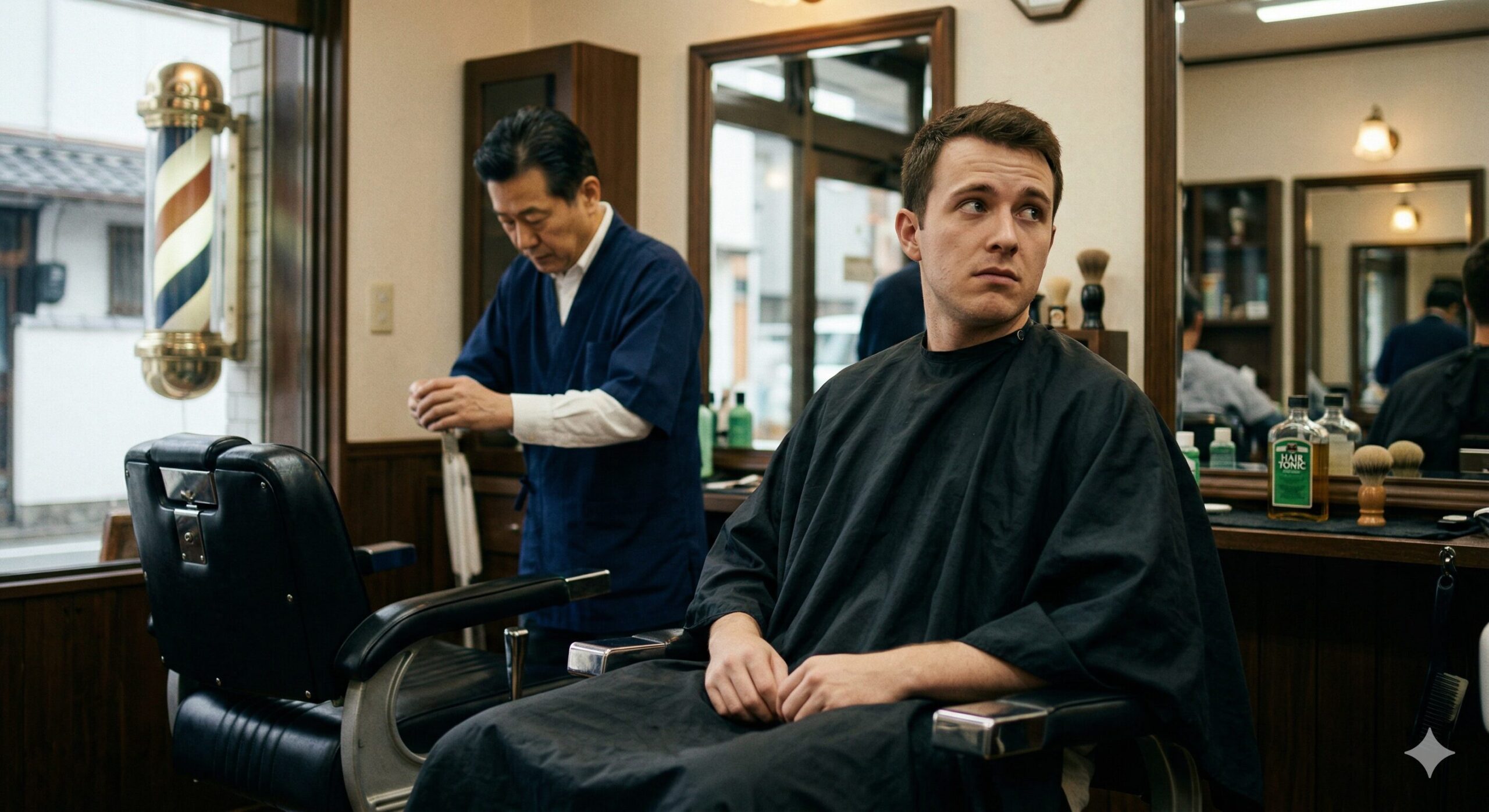
You step out of the shop, run a hand through your hair, and pause.
It looks clean. Nothing is technically wrong. The barber was clearly skilled — you could tell just from watching him work.
But something is off.
Not the kind of off you can point to in the mirror. Just… not the haircut you had in your head.
Sound familiar?
This happens more than you’d think — and almost never for the reason people assume.
Price: What It Does (and Doesn’t) Guarantee
This is the first thing everyone worries about, so let’s deal with it first.
Japan’s barbershops range from budget chains at ¥1,500 for a quick trim, to high-end independent barbers at ¥6,000 or more. If you’re visiting from overseas, neither extreme will shock you.
But there’s an assumption that gets people into trouble:
“If I pay more, I’ll get a better result.”
Partially true. A higher price usually means more time, more skill, more care. But there’s a ceiling on what money can buy.
It cannot buy communication.
Someone who spends ¥2,500 at a local shop and says clearly — “Low fade, skin tight, leave the top long” — can walk out happier than someone who pays ¥7,000 and says “just make it look good.”
Price sets the stage. You still have to show up.
Language: Not the Problem You Think It Is
Most people expect this to be the biggest barrier. They practice phrases, worry about pronunciation, write things down.
And then they sit down — and something still goes wrong.
Here’s why: language is not the bottleneck. Shared priority is.
Consider this exchange:
“Short on the sides.”
“How short?”
“You know — short.”
Both people understand the words. Neither knows what the other actually wants.
“Short” can mean:
- A number 2 all around
- A skin fade that disappears into nothing
- Just cleaning up what’s already there
When you say a word without explaining what it means to you, the barber fills in the gap with what it means to them. They’re not being careless — they’re using their best professional judgment.
But that judgment is built on years of cutting Japanese hair, for Japanese clients, with Japanese expectations.
What “short” means in Tokyo may be very different from what you had in mind in London, Lagos, or Los Angeles.
The problem isn’t your English. It’s that you haven’t told them what matters most.
How People Actually Mess It Up
The mistakes follow a pattern. It’s almost always one of these three:
❶ Vague words with no intention behind them
“Make it look nice.”
“Short on the sides, longer on top.”
“I want it to look clean.”
These sentences are technically in English. But they carry almost no information.
A barber cannot work with “nice.” He needs to know: how low is the fade? Where does it start? Does the top get cut, or just the sides? How much skin do you want showing?
The words are there. The intention isn’t.
❷ A photo — without explaining why you chose it
This is the most common mistake. And it’s subtle.
You show the barber a photo. He looks at it. He nods. You feel relieved.
But what caught your eye in that photo?
Was it the height of the fade? The way the top sits? The texture? The lineup at the temple?
He’s looking at the whole picture. You might be focused on one specific detail. Unless you point to that detail and say “this part — this is what I care about” — he’s guessing.
And he’ll guess well. Just not necessarily correctly.
❸ Staying silent when something feels off
This one stings to admit, but it’s real.
You’re in the chair. The barber is working. You can already feel that the line is sitting higher than you wanted. Something about the shape doesn’t feel right.
And you say nothing.
Because it’s awkward. Because you’re not sure how to say it. Because maybe it’ll look different when it’s finished.
It usually doesn’t.
The moment to adjust is during the cut — not after. One sentence is enough:
“Could you take it a little lower?”
A simple gesture toward the mirror works just as well.
Silence isn’t politeness. It’s a missed opportunity.
The Fix (It’s Simpler Than You Think)
Here’s what actually works. And it’s not about saying more.
Before you sit down, decide one thing:
What is the single detail that, if it’s wrong, ruins the whole cut?
Is it the height of the fade? Say that first.
Is it keeping length on top? Lead with that.
Is it the connection at the temple? Point to it in the mirror.
One clear priority, stated at the start, does more than five minutes of explanation.
Then — this is the part people skip — check in once during the cut. Not to hover. Just a quick glance in the mirror and a nod, or a small correction if needed.
Clarity of priority beats perfect explanation. Every time.
Summary
Getting a great fade in Japan is completely possible.
The skill is there. The prices are fair. The shops are clean, professional, and often excellent.
The only gap between “good cut” and “exactly what I wanted” is communication — and not the kind that requires perfect language.
You need three things:
- Know what matters most to you
- Say it first
- Stay present during the cut
That’s the whole game.
Now go get that fade. 💈


Comments