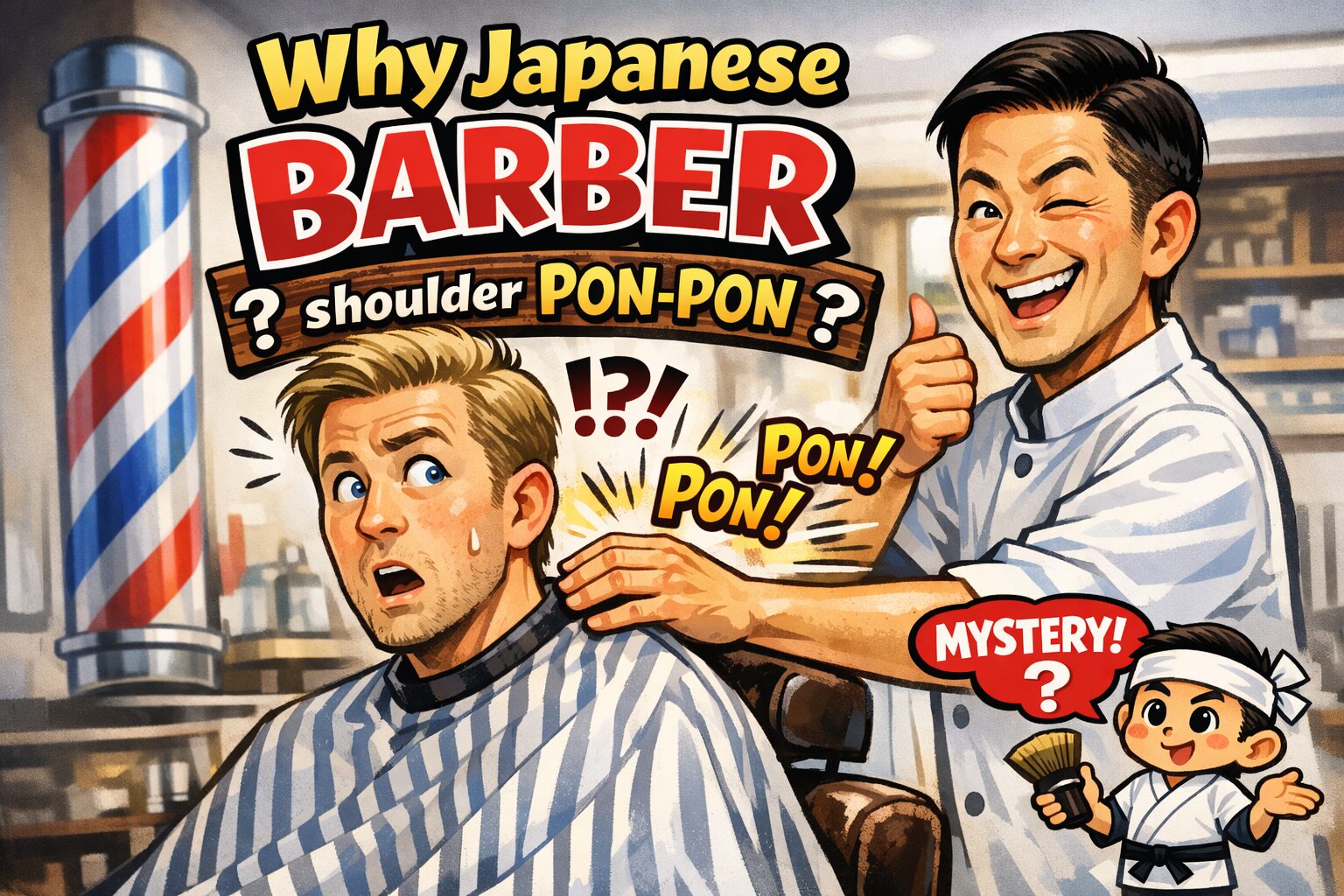
Quick answer: Those few light taps on your shoulders at the end are called “Pon-Pon.” They mean “all finished, thank you for coming.” It’s free, it’s optional, and you don’t need to do anything in response.
The haircut is done. The barber steps behind you and — pon, pon — taps your shoulders a few times.
And you freeze slightly. Was that a massage? Am I supposed to react? Is this going on the bill?
You’re not the first person to wonder. Here’s what it actually is.
What It Is
Shoulder Pon-Pon (肩ポンポン) is a short finishing gesture in Japanese barbershops. A few light taps, sometimes a brief squeeze, on both shoulders. It lasts a handful of seconds — not a massage in any real sense.
It carries two meanings at once:
- “Your haircut is complete.”
- “Thank you for coming in.”
In a shop where nobody has been talking much, it functions as punctuation — the clear signal that the service has ended.
Where It Falls in the Service
A typical barbershop flow looks like this:
Cut → shave (if included) → shampoo → Pon-Pon → final styling
So it usually arrives after the shampoo and just before your hair gets set. If you chose a menu without shampoo, some shops skip it entirely — it varies by shop, and either way is normal.
Why Barbers Do It
① It’s a closing signal
Japanese service tends to have a clear ending — a bow, a hand gesture, a phrase. The Pon-Pon is the barbershop version. It tells you the work is finished without anyone needing to say it.
② It releases the sitting tension
You’ve been holding your head still for thirty to sixty minutes. Your shoulders have quietly tightened without you noticing. A few taps loosens that before you stand up.
③ It’s hospitality, in miniature
The idea is that you should leave in a slightly better state than a haircut alone would produce. It’s a small gesture, and that’s exactly the point.
It’s Much Softer Than It Used to Be
Older-generation barbers sometimes did this with real force. The modern version is deliberately gentle — closer to a tap than a strike.
If it still feels stronger than you’d like, one sentence fixes it: “More softly, please.” It’ll be adjusted immediately and nobody will think anything of it.
Your Questions, Answered
Is there an extra charge?
No. It’s always included, and there’s no tipping in Japan either. Nothing is being added to your bill.
Do I need to respond?
No. You don’t have to say anything, move, or react. A small nod or “thank you” is perfectly nice, but silence is completely normal too.
Can I decline it?
Absolutely. “No shoulder massage, please.” Plenty of customers say this and barbers are entirely used to it. Some people are simply ticklish — I’ve been there myself.
Is declining rude?
Not at all. Preference is respected here; that’s the whole philosophy of the service.
Why didn’t I get one?
Either your menu didn’t include a shampoo, or the shop simply doesn’t do it. Both are common. It isn’t a comment on you.
Other Small Things That Happen at the End
The Pon-Pon rarely arrives alone. Around the same moment you may also get:
- A soft brush around the neck and collar to clear loose hair
- A warm towel on the face or neck
- The cape removed slowly rather than pulled away
- A hand mirror held up so you can see the back
These are all part of the same idea: the ending of the service is treated as carefully as the cutting.
Summary
- ✔ A few light taps meaning “all done, thank you”
- ✔ Free — never an extra charge, never a tip
- ✔ Gentle, and adjustable if it isn’t
- ✔ Entirely optional — decline freely
- ✔ No response required from you
It’s a tiny tradition, and one of those small things visitors tend to remember long after they’ve forgotten the haircut itself.
Let’s BARBER!! 💈
Related Guides
👉 First Time at a Japanese Barber Shop: What to Expect
👉 Japanese Barber Etiquette: What to Do (and Not Do)
👉 Why Japanese Shampoo Is So Good
Comments