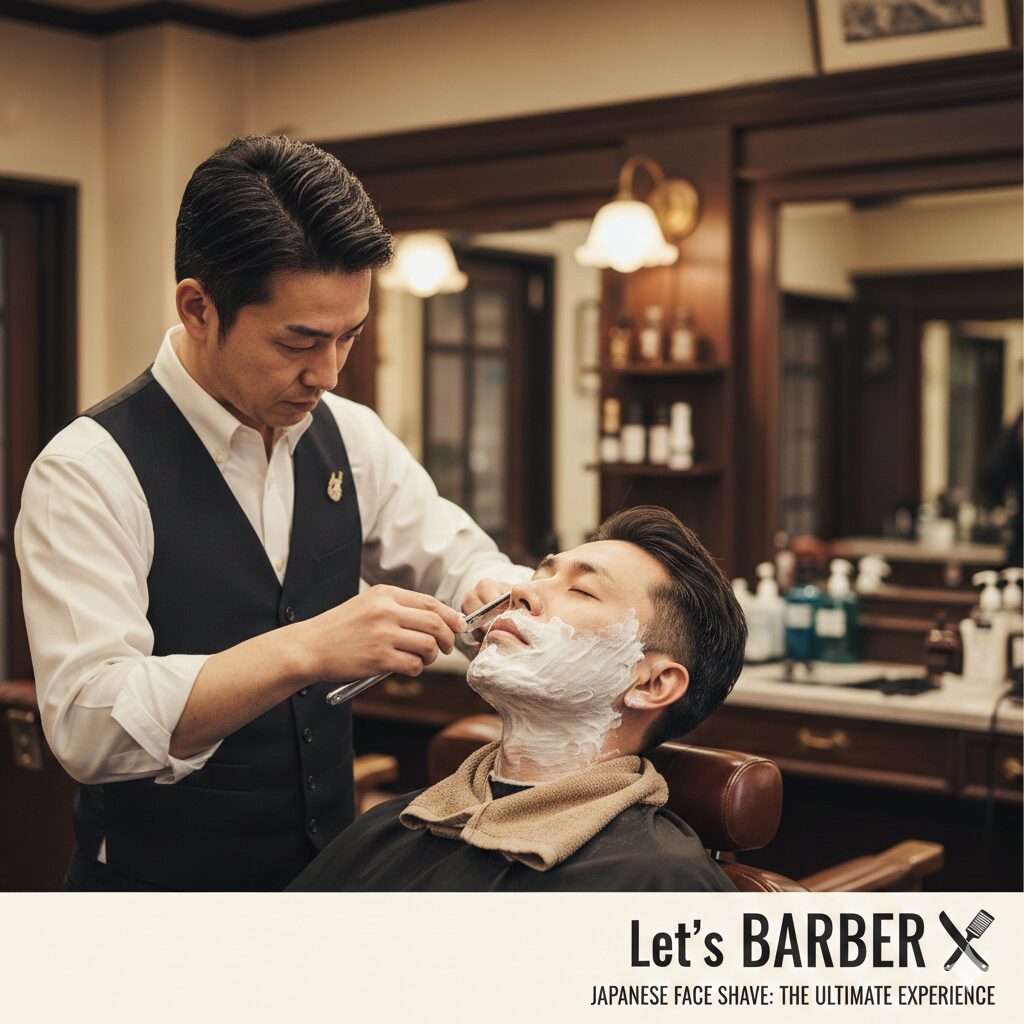
Quick answer: Japanese barbershop shaving removes fine facial hair, brightens your skin tone, and reshapes your facial lines — results you simply can’t get from shaving at home. Safe, relaxing, and open to first-timers. Here’s exactly what to expect.
“Is a face shave at a Japanese barber really that different?”
“Is it safe if I’ve never done it before?”
If you’ve seen someone walk out of a Japanese barbershop glowing — you’re asking the right questions.
Japan’s professional barbers have been mastering this ritual for generations. Here’s what makes it different, and why it’s worth trying on your first visit.
Key Takeaways
✔ Professional shaving removes fine facial hair (産毛) that home razors can’t reach — skin tone visibly brightens
✔ The difference comes from technique, not just tools — it takes years to develop
✔ Results: brighter skin, sharper lines, better skincare absorption
✔ Only 理容室 (riyōshitsu) — traditional barbershops — are licensed to offer this
✔ It’s safe, and you don’t need Japanese to ask for it
① What Actually Changes After a Professional Shave
Home shaving removes visible beard hair. That’s it.
Japanese barbershop shaving goes further — removing fine facial hair (産毛, ubuge) that covers the entire face. Hair so fine you’ve never thought of it as “hair” at all.
Here’s what changes when that layer is gone:
✔ Skin tone brightens — fine hair diffuses light and makes skin look dull. Remove it, and the difference is immediate
✔ Skincare absorbs better — moisturizer and serum go directly into skin instead of sitting on top
✔ Facial lines sharpen — eyebrows, sideburns, neckline all cleaned up with precision
✔ Makeup applies smoother — foundation no longer catches on fine hair
(I’ve watched customers look in the mirror after a full shave and genuinely not recognize themselves for a moment. That’s not an exaggeration.)
② Why Home Shaving Can’t Replicate This
It’s not about the razor. It’s about the hands.
Japanese barbers use a straight razor (カミソリ) with techniques that take years to develop:
- Skin tension — one hand stretches the skin taut while the other shaves, reaching angles impossible at home
- Grain direction — shaving with and against the grain in precise sequence, not just one pass
- Circular hand movement — not a straight drag, but subtle rotations that lift and cut simultaneously
A cartridge razor shaves what it can reach. A trained hand shaves what it should reach.
③ The Full Ritual: Step by Step
Step 1: Hot towel (蒸しタオル)
A warm, damp towel placed over the face. Opens pores. Softens every hair follicle. Feels incredible — take a breath and let go.
Step 2: Shaving cream
Professional lather applied by brush. Completely different texture from anything in a can.
Step 3: The straight razor
The main event. Precise, unhurried, thorough. Both directions. The room gets quiet.
Step 4: Detailing
Eyebrows, sideburns, neckline, nape. Every line cleaned up.
Step 5: Moisturizer / cooling lotion
Skincare product to finish. Your face will feel cooler, tighter, and somehow lighter.
The whole process takes 20–30 minutes. Most people close their eyes halfway through.
④ Is It Safe? (First-Timers, Read This)
Yes — completely.
Japanese barbers are licensed professionals. The straight razor is either single-use or properly sterilized between clients. Safety standards here are strict.
In fact, a professional straight razor causes less irritation than a multi-blade cartridge razor — because it cuts cleanly in one pass instead of dragging repeatedly.
A few things to mention beforehand if relevant:
✔ Active acne or broken skin — let the barber know before starting
✔ Very sensitive skin — mention it (phrase below)
✔ First time — just say so. Barbers here are used to first-timers and will adjust accordingly
⑤ Who Should Try It?
This is for you if:
✔ You have an important event — presentation, date, ceremony
✔ You want noticeably cleaner, brighter skin without changing your skincare routine
✔ You’re curious about a craft that most of the world has forgotten
✔ You want the full Japanese barbershop experience, not just a haircut
First time? Start with the nape shave (うなじ) — a gentler area, often included in a basic haircut. A low-pressure way to get comfortable before a full face shave.
⑥ Where to Go + What to Say
Only 理容室 (riyōshitsu) — traditional Japanese barbershops — are licensed to offer face shaving. Hair salons (美容室) cannot.
To add shaving to your haircut:
「シェービングもお願いします。」
Shēbingu mo onegai shimasu.
“Please include shaving too.”
To ask if shaving is available:
「シェービングはできますか?」
Shēbingu wa dekimasu ka?
“Do you offer shaving?”
If you have sensitive skin:
「肌が敏感です。」
Hada ga binkan desu.
“My skin is sensitive.”
No Japanese? Point to your face and say “shaving?” — it works every time.
Typical cost: ¥500–¥1,500 as an add-on to a haircut.
Summary
Japanese barbershop shaving isn’t just about removing hair.
It’s about what’s left behind — brighter skin, sharper lines, a face that looks like it’s been properly taken care of.
A ritual that takes skill, time, and attention to detail that a 3-minute routine at home simply can’t touch.
Try it once. You’ll understand immediately why customers keep coming back.
Let’s BARBER!! 💈
Want to Communicate More Smoothly at the Barber?
Our Barbershop Communication Sheet has all the key phrases ready to show — haircut styles, shaving requests, skin concerns, and more. No Japanese required.
👉 Get the Communication Sheet on BASE
https://letsbarber.base.shop
Next article: 👉 Japanese Barber Etiquette: What to Do (and Not Do)
https://www.lets-barber.com/japanese-barber-etiquette/

Comments