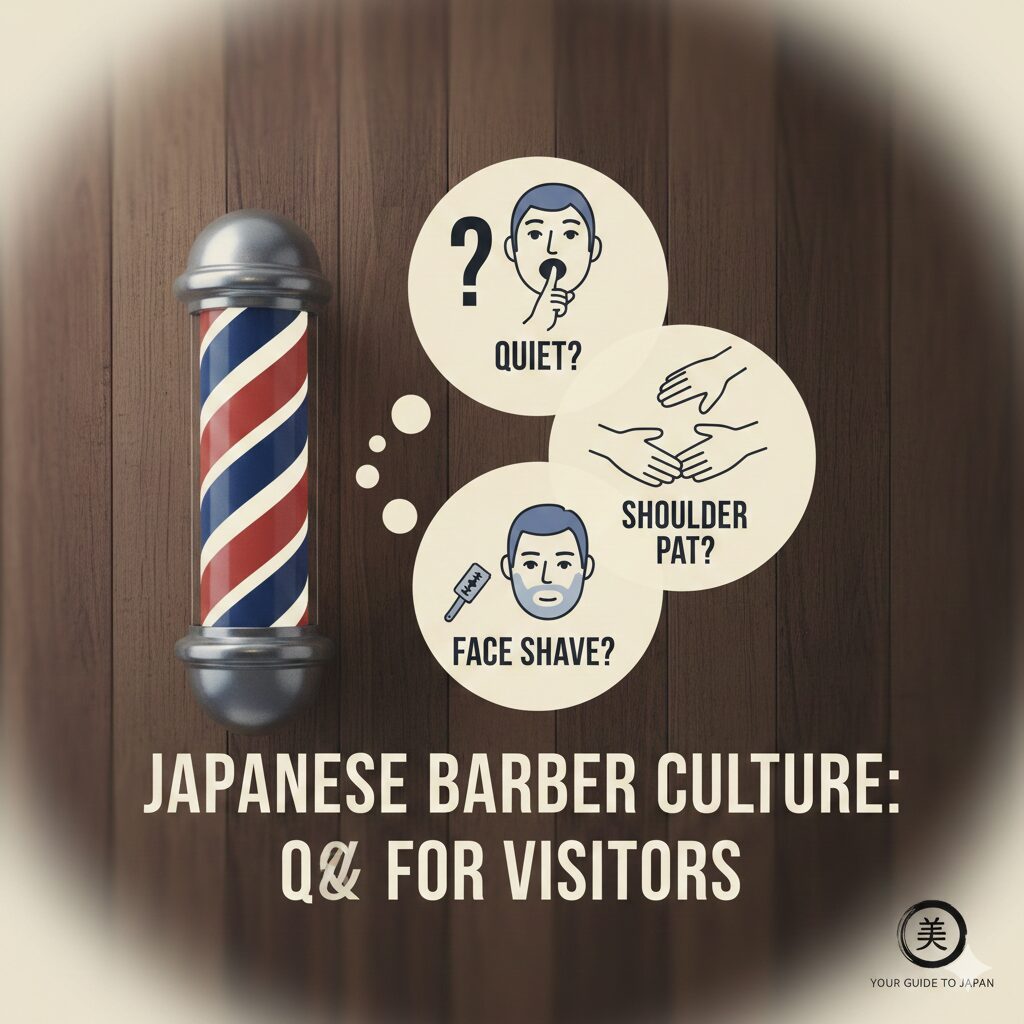
- Shoulder Pon-Pon, Silence, and Shaving Explain
- ✨ Introduction (Key Point First)
- 🧭 What You’ll Learn in This Guide
- What Makes Japanese Barber Culture Different?
- Is It Rude That Japanese Barbers Are Quiet?
- What Is “Shoulder Pon-Pon”?
- Why Is Shaving Often Included?
- Do You Need to Tip at a Japanese Barbershop?
- Helpful Things to Know for First-Time Visitors
- ✨ Final Thoughts
Shoulder Pon-Pon, Silence, and Shaving Explain
✨ Introduction (Key Point First)
Japanese barber culture can feel confusing for first-time visitors,
but it is actually calm, respectful, and deeply service-oriented.
A Japanese barbershop is not a place where you are expected to talk nonstop,
nor is it a tense or intimidating space.
Instead, its main characteristics are:
- Quiet
- Careful and precise
- Respectful personal distance
For many visitors experiencing a Japanese barber for the first time,
this atmosphere may feel unfamiliar.
In this article, we’ll gently explain the unique aspects of Japanese barber culture,
focusing on the points that often cause confusion or anxiety if you don’t know them in advance.
🧭 What You’ll Learn in This Guide
- Why Japanese barbershops are often quiet
- What “Shoulder Pon-Pon” means
- Why shaving is often included
- What you don’t need to worry about regarding conversation, tipping, and manners
What Makes Japanese Barber Culture Different?
At the heart of Japanese barber culture is one key idea:
“Do not tire the customer more than necessary.”
This means:
- Not forcing conversation
- Letting the quality of the technique speak for itself
- Creating a calm and relaxing space
This mindset is slightly different from cultures where
“good service = constant conversation.”
Is It Rude That Japanese Barbers Are Quiet?
The short answer is: not at all.
In Japan:
- Quiet ≠ lack of interest
- Quiet = focus and respect
Especially with first-time customers,
barbers may intentionally limit conversation to what is necessary.
That said, does this mean you shouldn’t talk at all?
Not exactly — and this is where things can feel tricky.
As long as your conversation does not disturb other customers or interrupt the relaxed atmosphere, it is perfectly fine.
What Is “Shoulder Pon-Pon”?
In Japanese barbershops, you may notice a brief gesture near the end of the service:
a light tapping on the shoulders, known as “Shoulder Pon-Pon.”
This short action serves multiple purposes:
- Light massage → to ease tension from sitting
- A signal → “We’re almost finished”
- A polite gesture → “Thank you for your time”
It is not strong, and it does not last long —
usually just a few seconds.
Why Is Shaving Often Included?
Many Japanese barbershops include facial shaving as part of the service.
This tradition exists because shaving is seen as:
- A way to enhance cleanliness
- The final step to complete the haircut
- A core part of traditional Japanese barber culture
If you don’t want shaving, that’s completely fine.
You can simply say:
“No shave, please.”
Do You Need to Tip at a Japanese Barbershop?
No, tipping is not required.
In Japan, service and technical fees are already included in the price.
Not leaving a tip is never considered rude.
Helpful Things to Know for First-Time Visitors
- You don’t need to force conversation
- Even if English is limited, photos and gestures work very well
- Many barbers confirm requests using simple Yes / No questions
Japanese barbershops may be quiet,
but they are not cold or unwelcoming.
✨ Final Thoughts
Japanese barber culture values:
- Care over flashiness
- Respectful distance
- High-quality finishing
Even if it feels unfamiliar at first,
understanding the background makes the experience much more comfortable.
In the next articles, we’ll explore:
- How Japanese fades differ from Western fades
- How to choose a good barbershop in Japan for your first visit
Let’s BARBER!! 💈
👉 Next article: Japanese Fade vs Western Fade


コメント